Curriculum
Hillsdale K-12 Curriculum
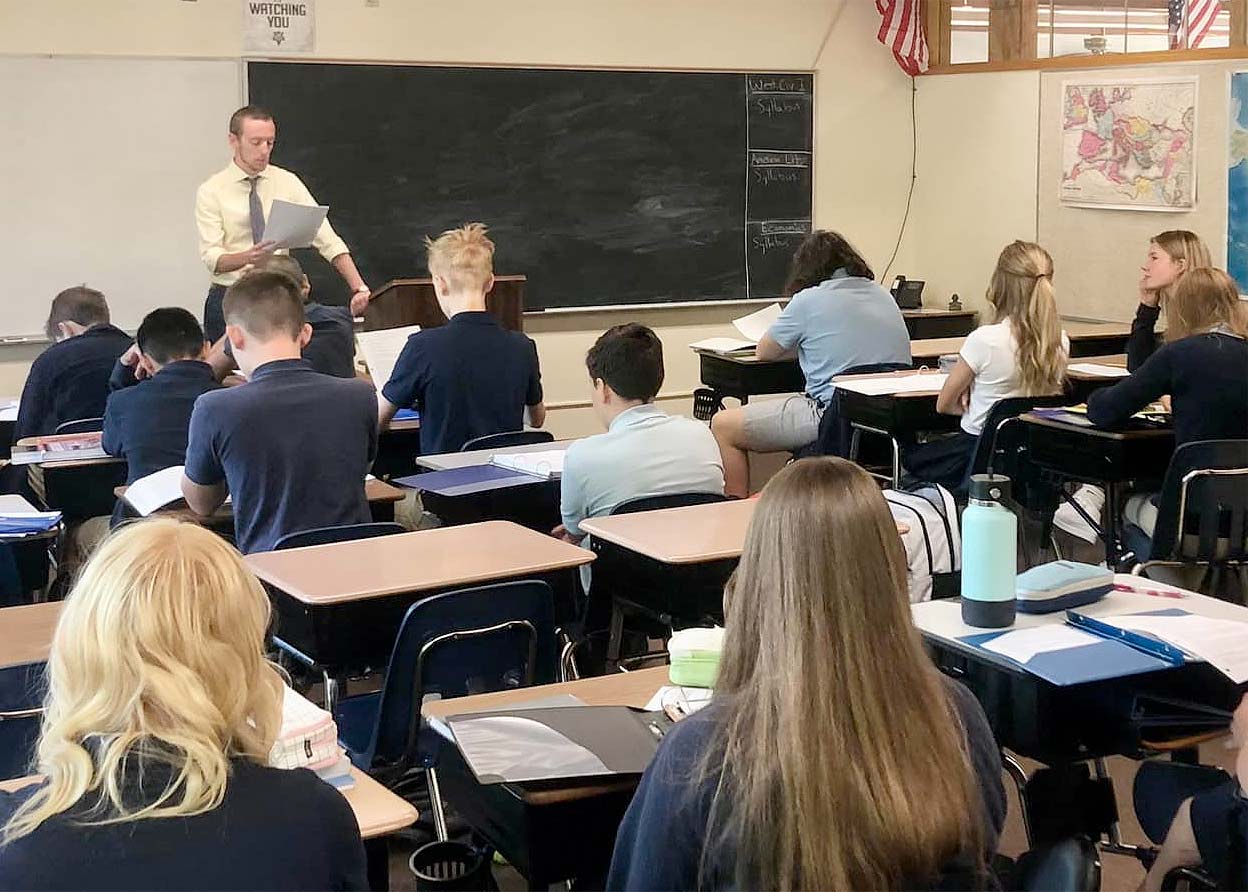
The Hillsdale K-12 curriculum provides the architecture for LCCA’s academic program, which emphasizes the core disciplines of math, science, history, and language arts, including phonics and writing, with significant attention to music, art, and foreign language. Courses in elementary science and history primarily focus on Core Knowledge readers, and instruction in the high school frequently utilizes primary text source material.
LCCA’s curriculum includes the multi-sensory, explicit phonics program, Literacy Essentials, developed from Orton-based research on language and cognition and produced by Access Literacy, LLC. Our curriculum utilizes the world-renowned Singapore Mathematics techniques centered on the developmental progression from concrete objects through a pictorial phase to the abstract level of understanding for Kindergarten through 7th grade. The Well-Ordered Language curriculum is the basis for formal grammar instruction in the upper elementary grades. LCCA includes instruction in Latin, beginning on a formal basis in 6th grade, preceded by the teaching of Latin and Greek roots in 4th and 5th grades.
In high school, LCCA continues the Hillsdale K-12 course sequence. This includes four years of history; four years each of literature, math, and science; two years of foreign language; one year of composition, and a semester each of government, economics, and moral philosophy. Students study history through primary source documents to foster analytical skills and insight into their culture and heritage.
Instruction in the classical virtues is introduced in the elementary program and continues through the upper grades as a necessary support of the classical curriculum. The program introduces and seeks to instill virtues of morality through the pillars of character education: honesty, courage, responsibility, respect, and wisdom.
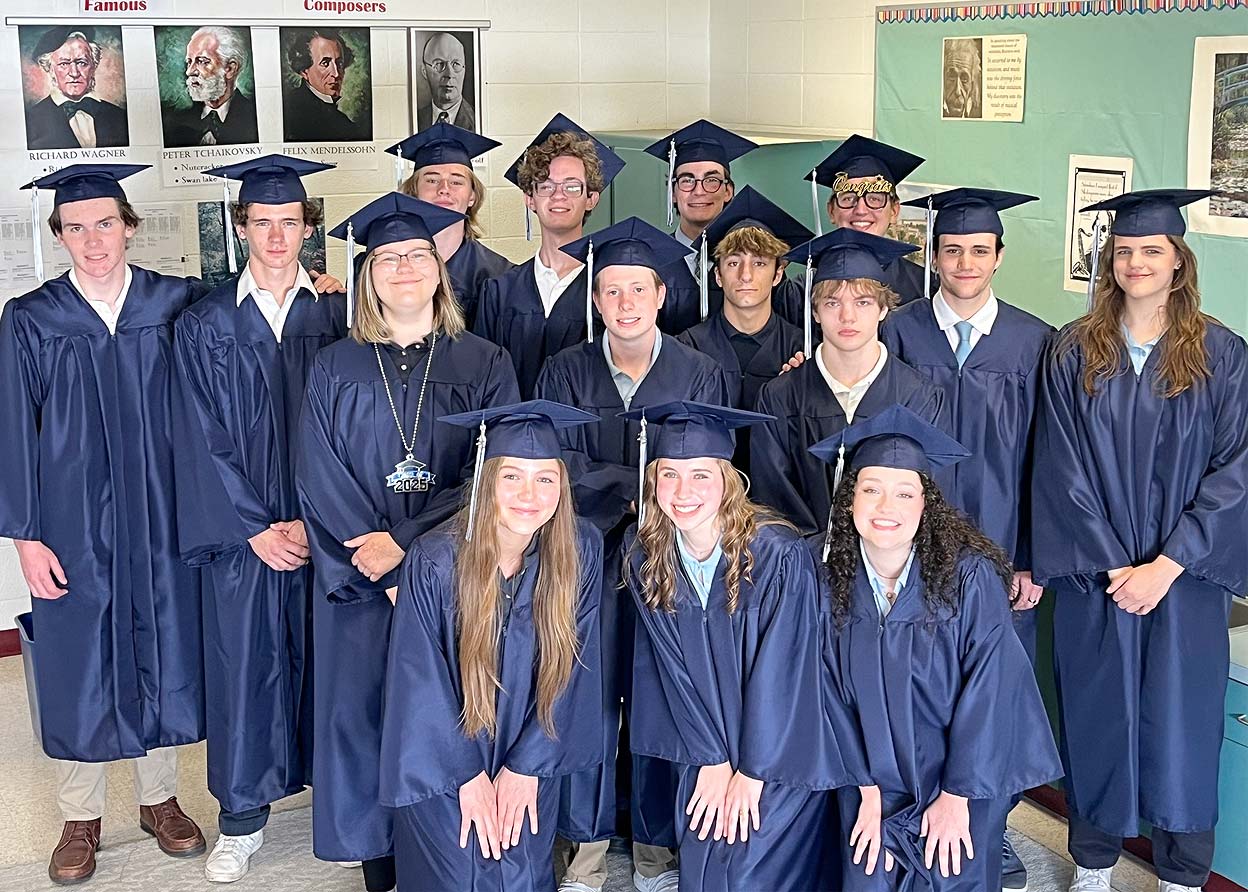
Graduating from
Lake Country Classical Academy
Instruction in the classical virtues is introduced in the elementary program and continues through the upper grades as a necessary support of the classical curriculum. The program introduces and seeks to instill virtues of morality through the pillars of character education: honesty, courage, responsibility, respect, and wisdom.
High school students completing the Hillsdale K-12 course sequence will receive a high school diploma, as permitted by LCCA’s independent, charter school status and the WI Department of Public Instruction. LCCA Provides support to high school students through our college counseling department. Graduation requirements may be found HERE.
Portrait of a GraduateGrades K-8 Curriculum Sheets
We invite you to download our Classical Curriculum sheets for grades K-8.
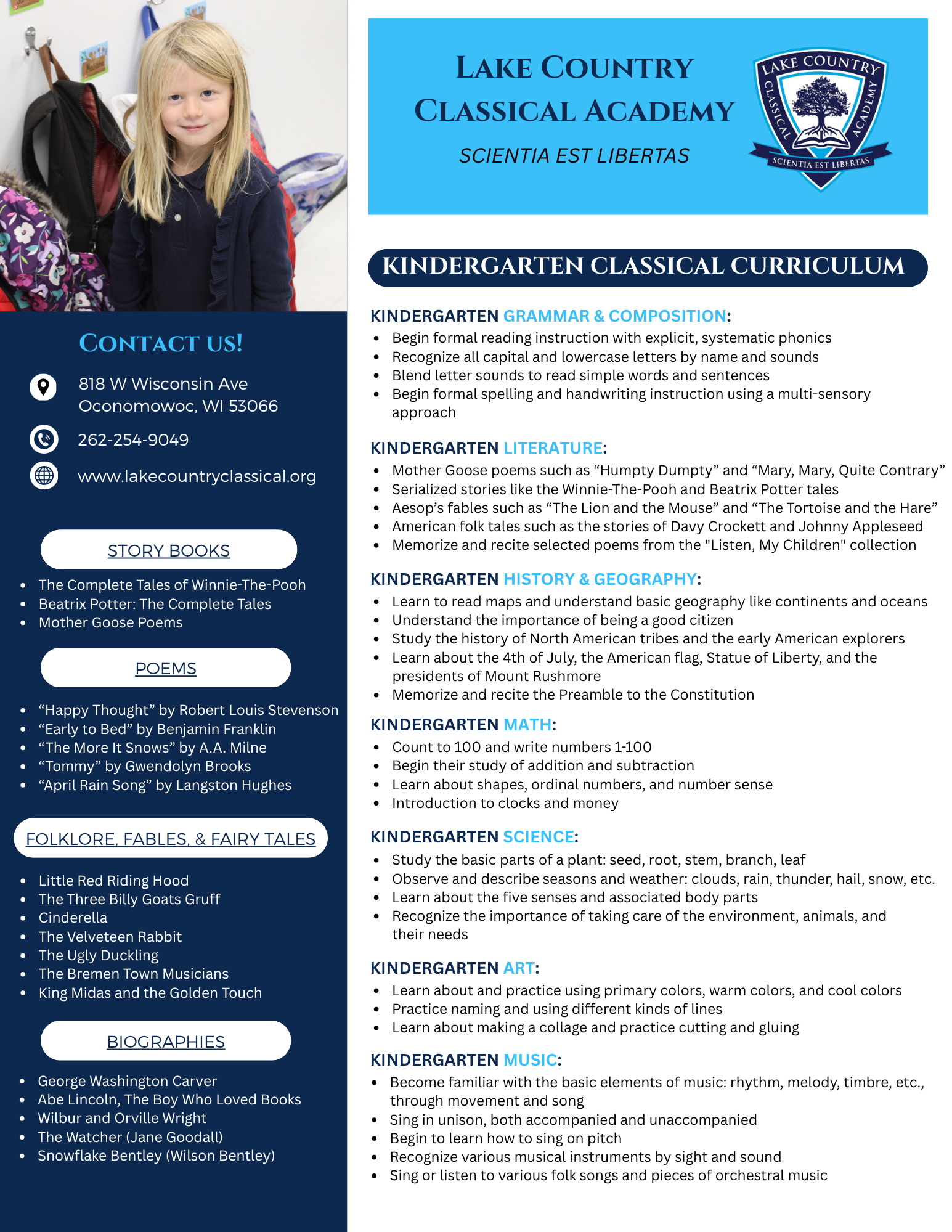 Kindergarten
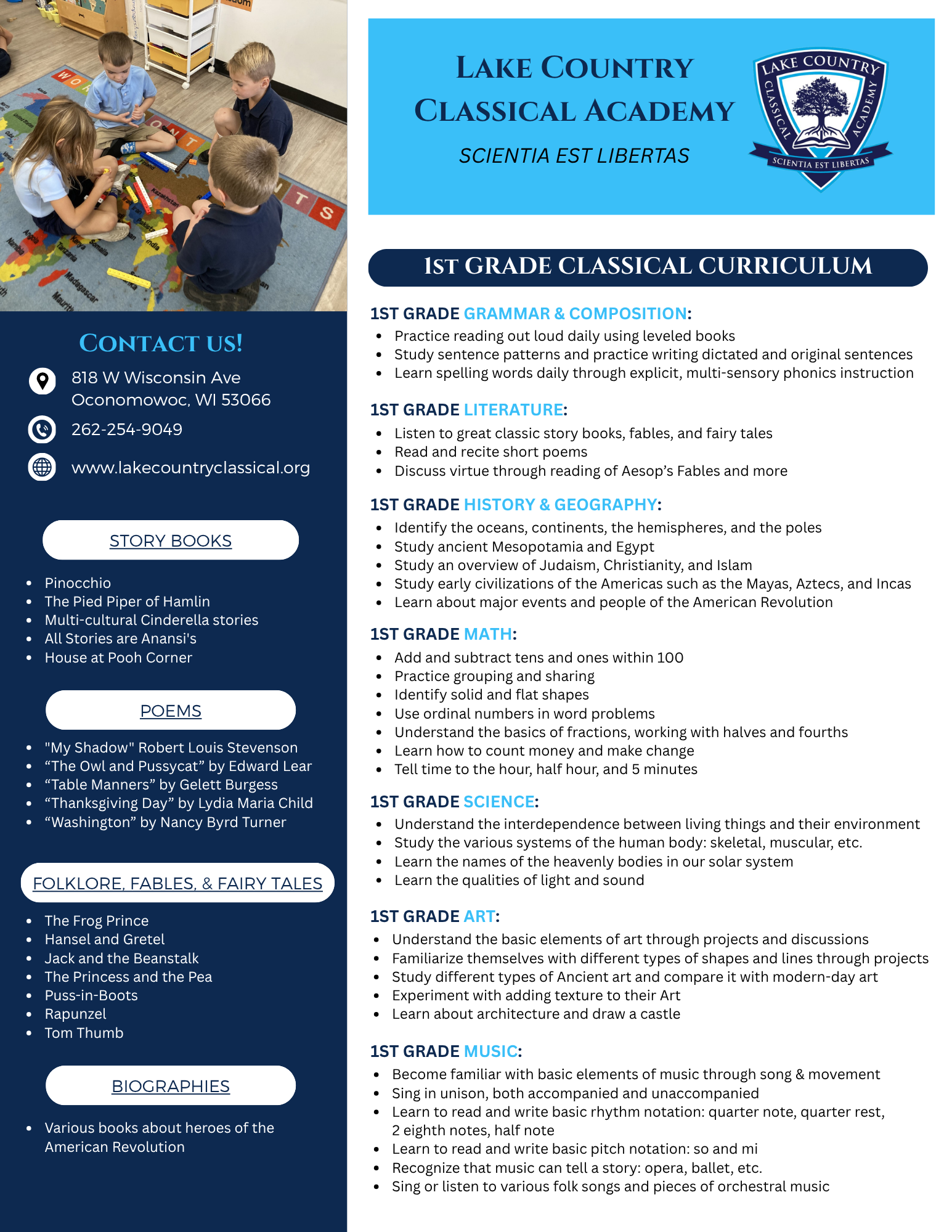 First Grade
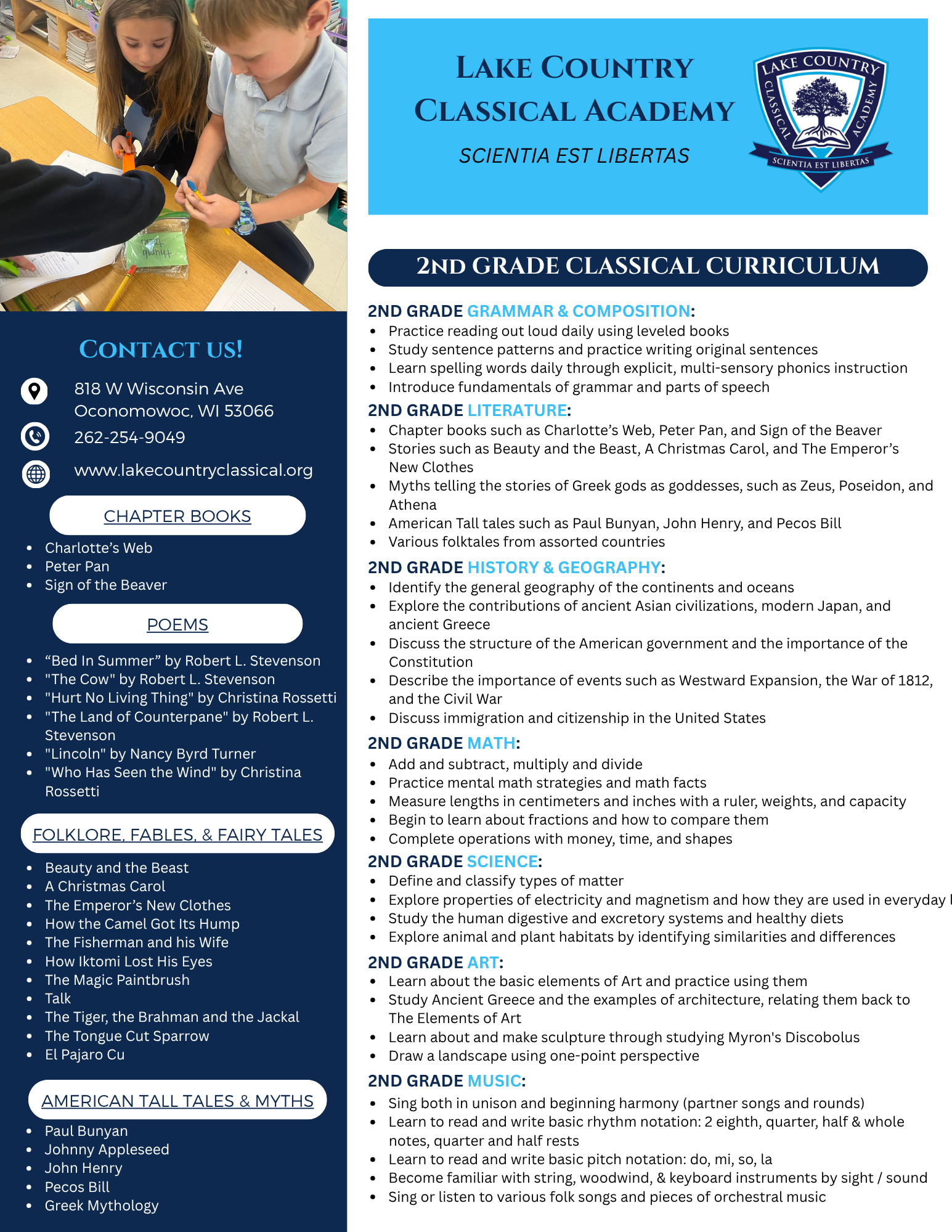 Second Grade
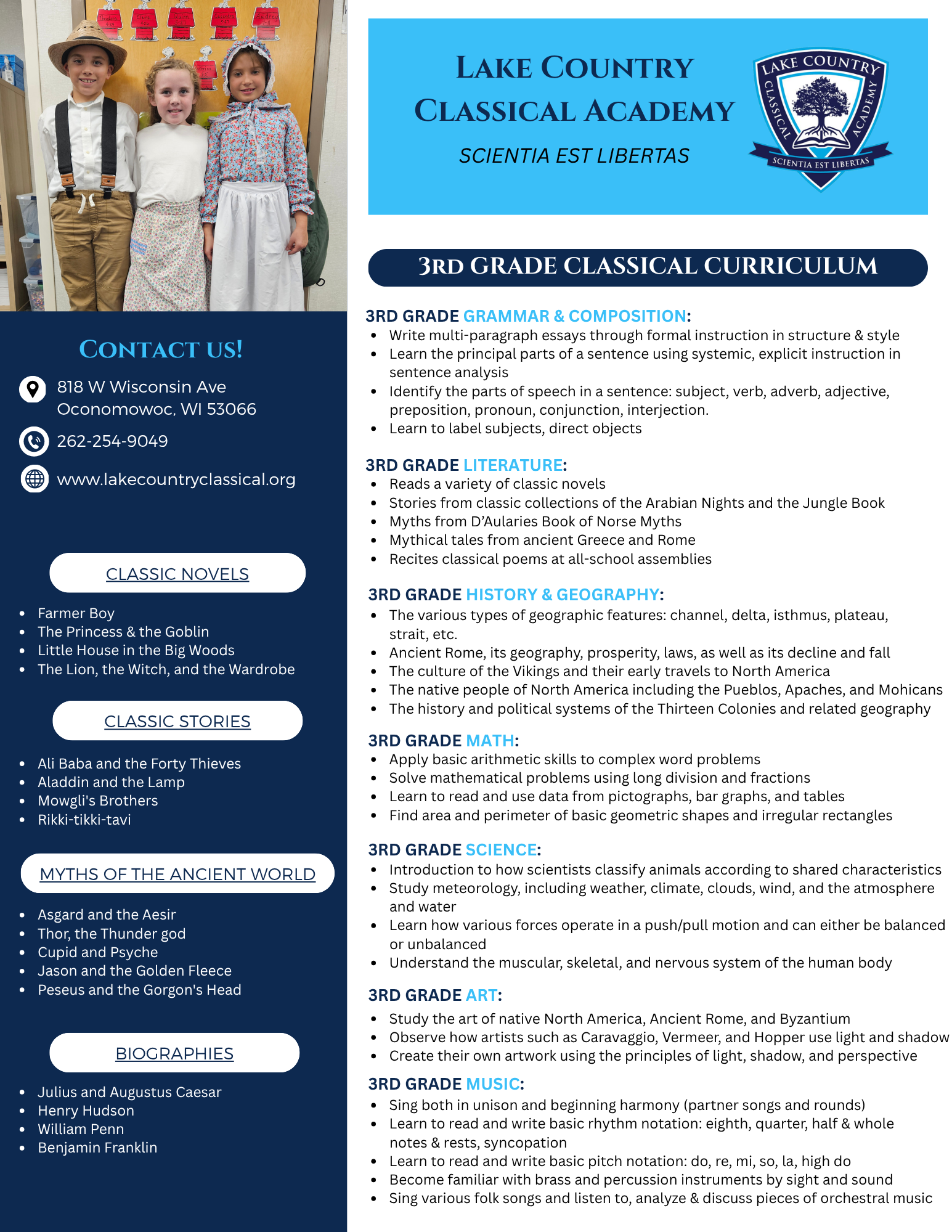 Third Grade
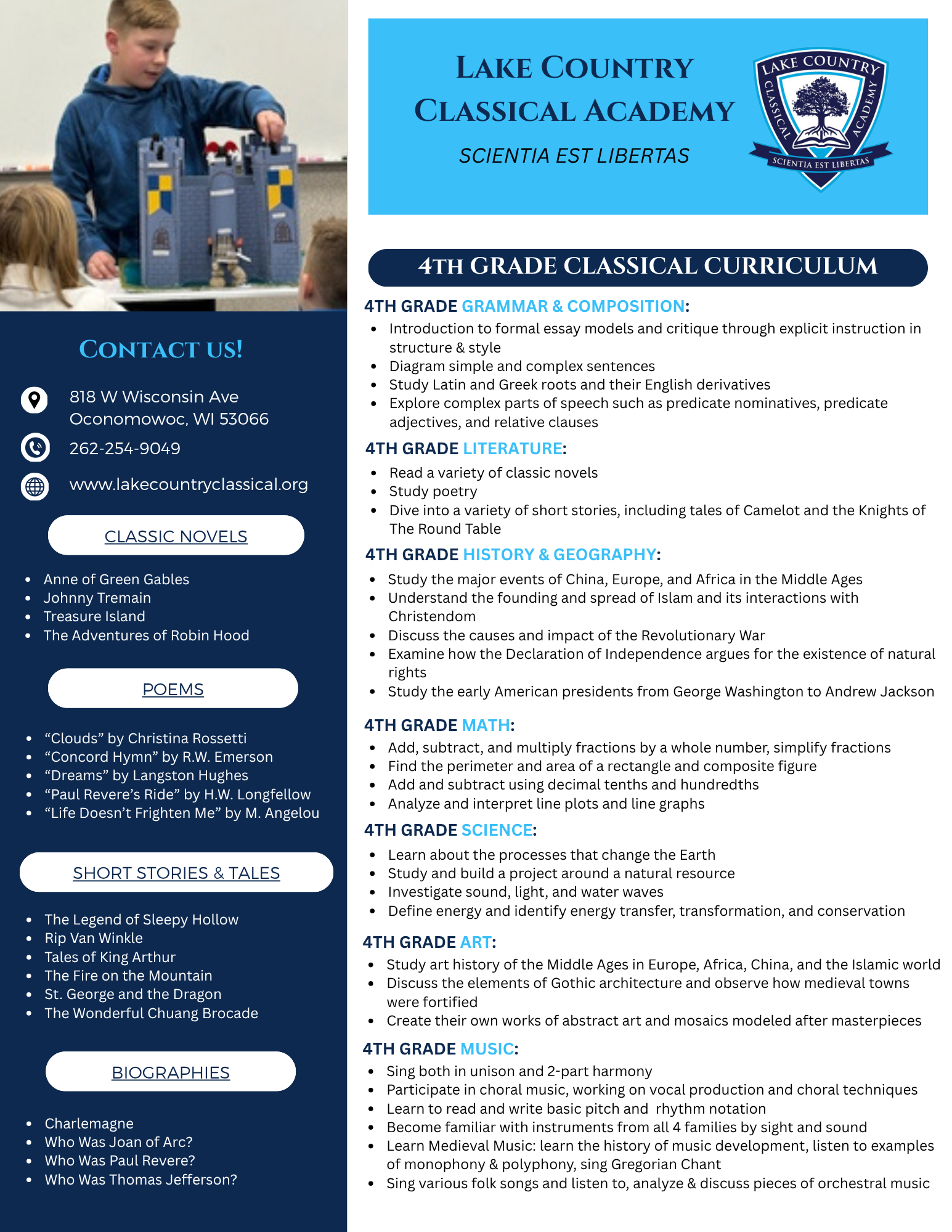 Fourth Grade
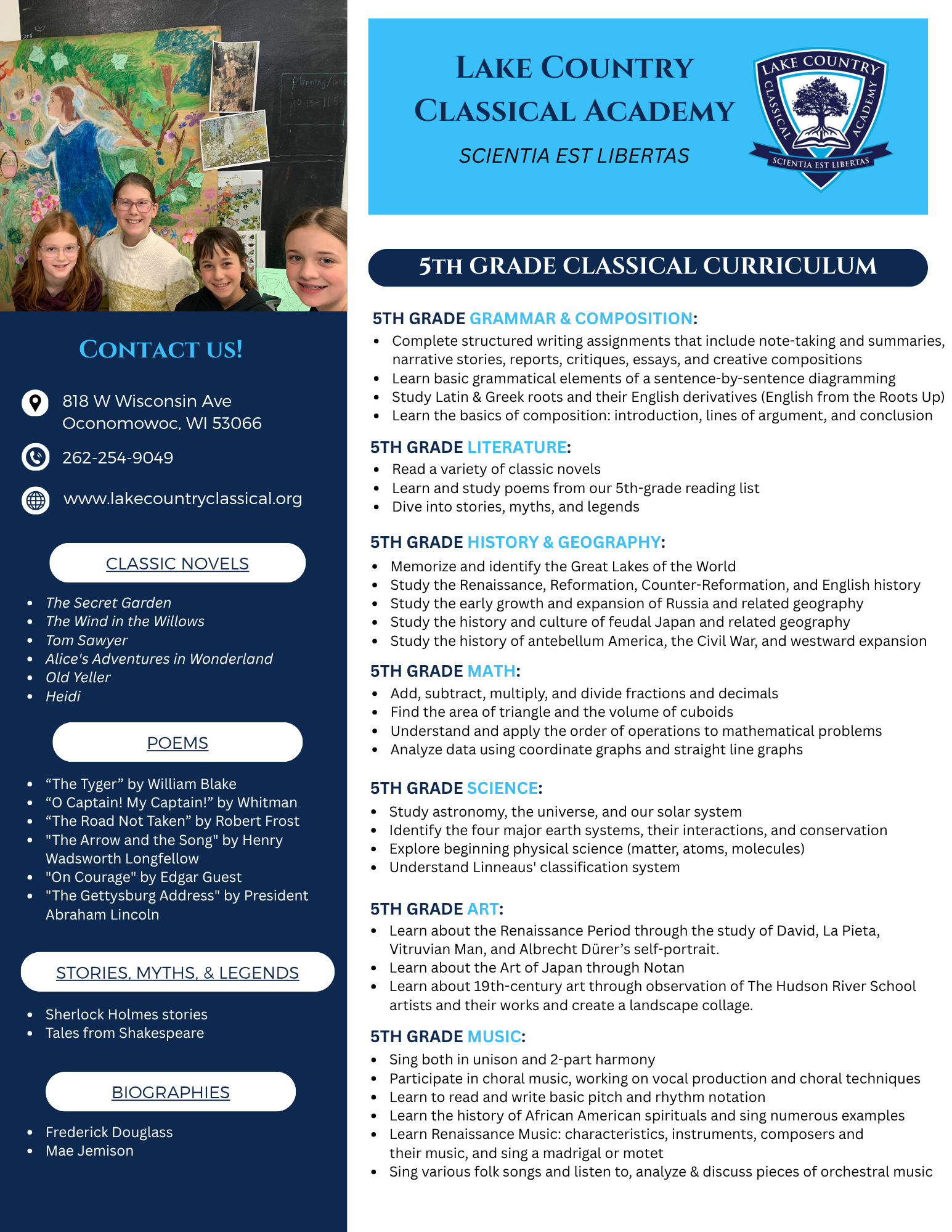 Fifth Grade
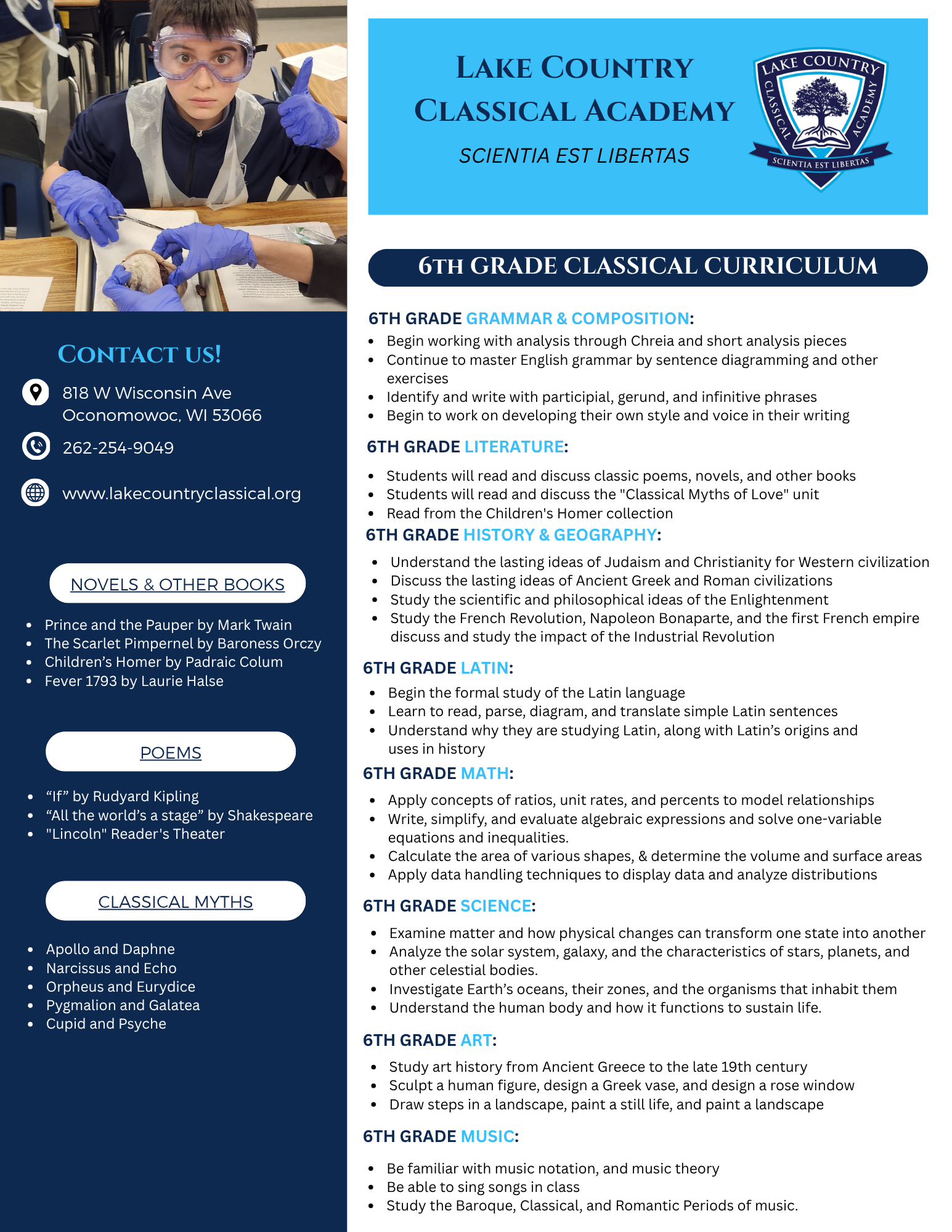 Sixth Grade
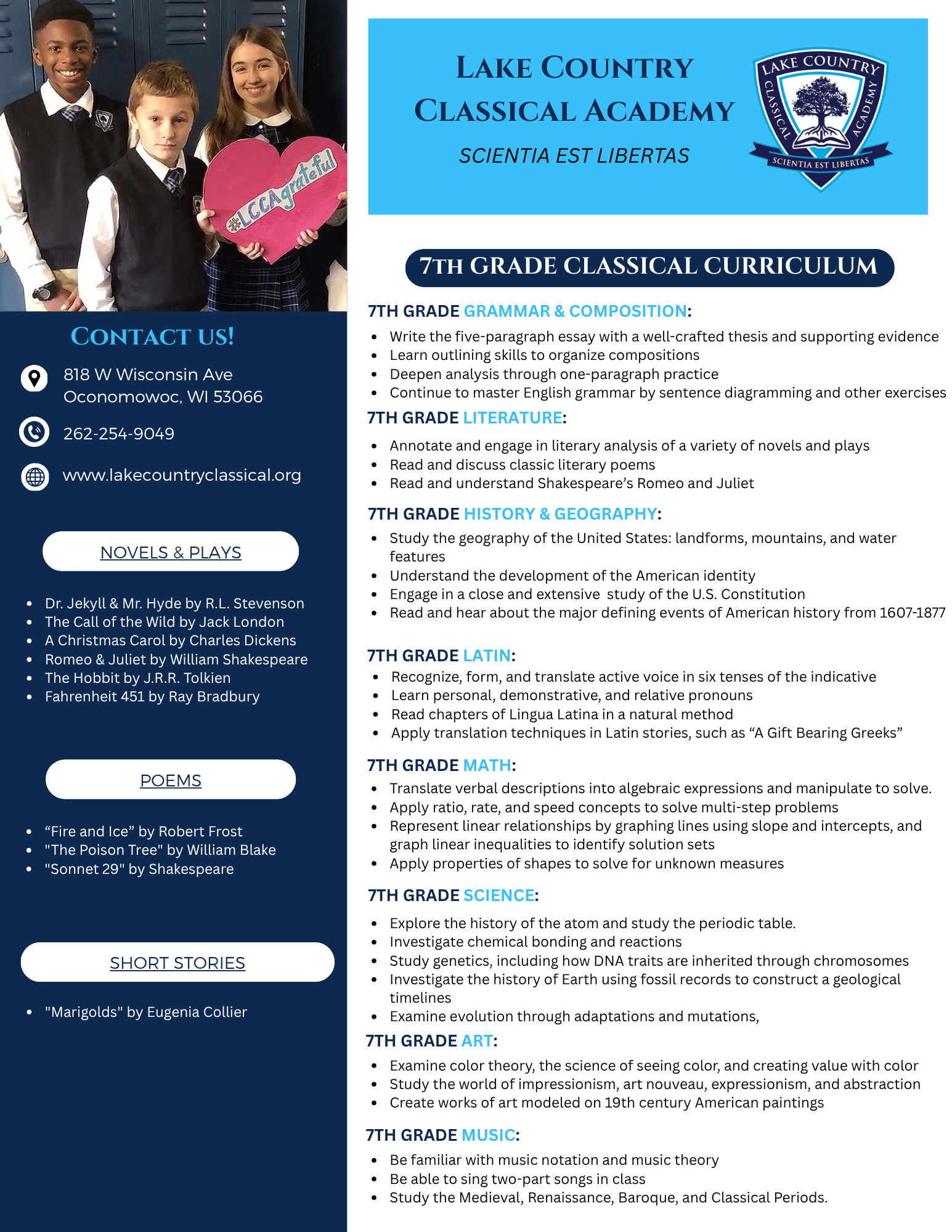 Seventh Grade
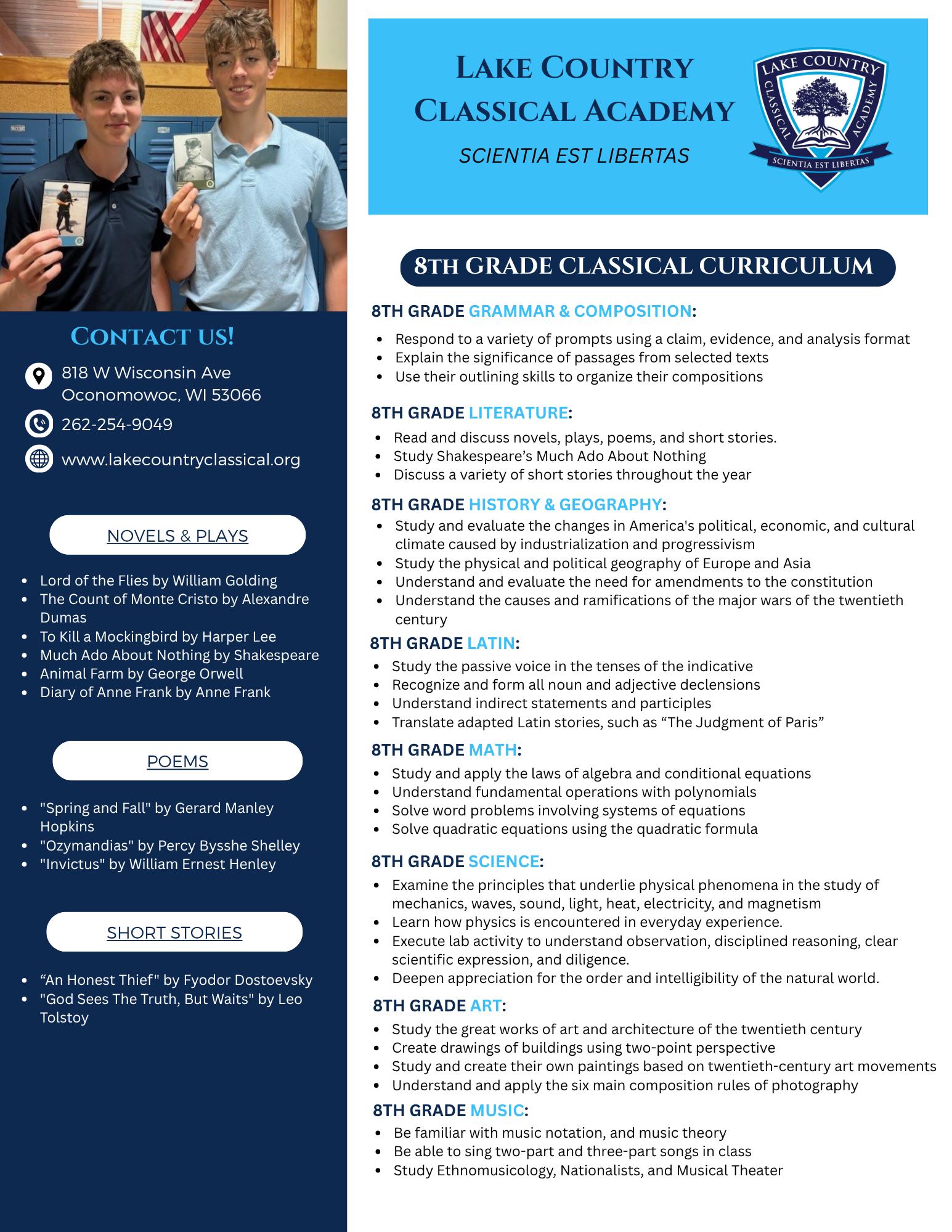 Eighth Grade
High School Course Catalog & Descriptions (Grades 9-12)


Grade 9 | Full-Year Course: Ancient Literature (REQUIRED): In this course, students will experience the three great epics of the classical world: The Iliad, The Odyssey, and The Aeneid. These poems reach out to us across the centuries, as relevant as ever, undiminished in their force and creative power. We will begin with Homer, the world’s first great storyteller, and conclude with Virgil, who was perhaps the most talented poetic craftsman in history. Our goal will be to engage with these texts on a deep level and to participate in the worlds they contain. Students will discover what makes a work of art truly great. They will examine the questions these works ask about human nature and explore some of the answers they provide. This course will favor quality over quantity. We will move deliberately through the complete texts, which will allow us to examine them in great detail.
Grade 10 | Full-Year Course: British Literature (REQUIRED): As an introduction to British literature, this course shall begin with a survey of the origins of the British literary tradition through Old English and Middle English texts before moving on to the works of the Renaissance and Victorian eras. Along the way, we shall trace the ways in which this tradition evolved, giving shape to—and being shaped by—the historical experience of the British people. Students will be required to engage with these texts on a deep level through personal reflection and analysis, conversation, and written assignments.
Grade 11 | Full-Year Course: American Literature (REQUIRED): Students dwell on the qualities of great American works that make them, at once, universally human and uniquely American. They pay special attention to the critical views of the authors studied in order to understand what particular duties these authors felt had been placed upon their language and their art. Main works include Nathaniel Hawthorne’s The Scarlet Letter, Herman Melville’s Moby Dick, and Mark Twain’s The Adventures of Huckleberry Finn. Other authors include Ralph Waldo Emerson, Walt Whitman, Emily Dickinson, Robert Frost, and T.S. Eliot.
Grade 12 | Full-Year Course: Modern Literature (REQUIRED): In this course we will examine the ways that the twentieth century shaped modern consciousness. In particular, we will explore the ways in which the abandonment of traditional ideas about man, nature, and reality gave rise to the “demons” of the century; how the loss of confidence in truth, goodness, and beauty led to a sense of alienation and cynicism; and how the increasing reliance upon scientific truth at the expense of moral truth gave rise to a host of ethical and moral ambiguities that pervade the Western societies of the present day. We will examine the works of T.S. Eliot, Joseph Conrad, Fyodor Dostoevsky, and several other writers who saw the truth beneath the appearances of the age and spoke it. Their words serve both as a warning and a rallying call for us in the present to redeem the time by reawakening us to the reality of “The Permanent Things.”
Grade 9 | Full-Year Course: Ancient History (REQUIRED): Students begin with a brief overview of ancient Mesopotamian Civilizations (~3500 B.C.) before proceeding to a more thorough survey of Greek and Roman civilization. The course concludes with the Fall of the Roman Empire (476 AD/CE) and the birth of Christendom, to be continued in 10th-grade European History. Students will study the political and philosophical foundations of Western Civilization, engage with historic figures from Moses to Pericles to Julius Caesar, and begin studying the question, “What are the historical origins of the Western Tradition?” In class and at home, students study maps and examine primary sources in translation to comment on their enduring significance.
Grade 10 | Full-Year Course: European History (REQUIRED): This course will cover the rise of Christian Rome to the outbreak of the French Revolution. We will seek to answer the following questions: What is the difference between the City of God and the city of man, and why are they in conflict with one another? Why did Europeans largely embrace the latter (secularism) by the end of the 18th century? Emphasis is on the use of primary sources in translation.
Grade 11 | Full-Year Course: American History (REQUIRED): Junior’s study American History from the colonial period through the modern age. Starting with the earliest humans crossing into North America and extending to the War on Terror, students will engage with their national history to understand the tremendous lessons it has to teach. Intense focus is given to the Founding and to the Civil War before progressing into the Industrial Revolution and America’s emergence on the world stage. Primary sources that the students read include many documents of the Founding period but also speeches, religious sermons, and personal letters. Texts that students may read in American History include: The Autobiography of Benjamin Franklin, Narrative of the Life of Frederick Douglass, and Land of Hope by Wilfred McClay.
Grade 12 | Full-Year Course: Modern History (REQUIRED): Students will follow the development of the Modern West from its emergence during the French Revolution as a secular, enlightened continuity, through Europe’s imperial consolidation on its own continent and abroad, and culminating in its descent into two wars, which dragged the rest of the world into war with it. This class will focus on the intellectual motives resulting in two world wars. This class will also focus on the intellectual motives that first inspired the Revolution, namely the three competing political philosophies in Europe derived from the writings of Hobbes, Locke, and Rousseau, and their development and mutation during the 19th and 20th Centuries. Philosophical and Psychological movements during this period will be heavily stressed, as will be their connection to literary and artistic movements accompanying them, as well as direct political movements that were directly or indirectly inspired by them.
Full-Year Course: Algebra I (REQUIRED): This course is an exploration into abstract arithmetic, specifically focusing on the foundational properties of algebraic manipulation, functions (linear, quadratic, and exponential, and the structure of exponential and radical expressions). Throughout the course, students will engage in the cyclical process of conceptualizing algebraic topics and developing and deploying the skills necessary to solve problems. This course will facilitate the active construction of student understanding of basic algebra through consistent revision of student preconceptions and through emphasizing the inherent structure of algebraic principles. Emphasis will be placed on deepening conceptual mastery while highlighting the importance of mathematics and its deeply rooted connection to our world. By the end of this course, students should be able to articulate answers to the following questions: What are the fundamental properties of mathematics, and how do you use them to solve linear, rational, and quadratic equations or simplify expressions? What is a function, and how can it be represented? What are the properties of linear, absolute value, quadratic functions, and exponential functions? What are the properties of radicals and exponents, and how can we utilize them to simplify complex expressions?
Full-Year Course: Geometry (REQUIRED): This course focuses on the study of geometric relationships in both plane and three-dimensional space. Students develop foundational geometric vocabulary and explore concepts of angles, parallel lines, and congruence. Instruction includes the analysis of planar figures such as triangles, quadrilaterals, polygons, and circles, as well as three-dimensional figures including prisms, pyramids, cylinders, cones, and spheres. Students learn geometric constructions, apply logical reasoning through proofs, and gain an introductory understanding of trigonometry. Emphasis is placed on problem-solving, precision, and mathematical reasoning.
Full-Year Course: Algebra II (REQUIRED): Prerequisite – Algebra I and Geometry: Students will learn to deploy their knowledge of algebraic procedure to evaluate functions. The year begins with a rapid review of algebraic manipulation, focused on radicals, exponents, and rational expressions; of linear systems of equations; and of quadratic functions, all with an emphasis on problem-solving and dealing with unexpected wrinkles in problems. While reviewing this material, the course introduces the complex number plane, quadratic and higher-degree inequalities, and radical inequalities. From there, the course delves into functions, combination and composition of functions, and inverse functions — exploring topics such as domain, range, asymptotes, monotonicity and continuity, increasing/decreasing and odd/even behavior, and end behaviors for a family of Precalculus-relevant parent functions, including rational, logarithm and exponential, radical, piecewise-defined, and polynomial functions. In the polynomial unit near the end of the year, students will explore the Fundamental Theorem of Algebra, the Rational Root Theorem, polynomial operations, and synthetic division as mechanisms for factoring polynomials. This course prepares students to enter LCCA’s Precalculus course and provides ample groundwork for students to pursue college-level Algebra courses in the future.
Full-Year Course: Pre-Calculus / Trigonometry: Prerequisite – Algebra II: This course develops a deeper understanding of and fluency with various function types, including polynomial, rational, exponential, logarithmic, trigonometric, and conic sections. While studying these functions, including their limits, students will explore a variety of useful skills in mathematics, like logical reasoning and notation, which are necessary to be prepared for the study of calculus and higher mathematics. Students will review the abstract thinking introduced in algebra as well as the spatial reasoning developed in geometry and apply it to solve more complex problems. Students will become familiar with transformations of functions, trigonometric ratios, exponent and logarithm rules and applications, trigonometric expressions and proofs, vectors and polar coordinates, matrices, and sequences and series. Emphasis will be placed on the development of logical reasoning and on using mathematics as a tool for problem-solving.
Full-Year Course: Calculus I: Prerequisite – Pre-Calc: This course will cover the mathematical representation of processes that involve change and their many applications. Students will explore various techniques for relating functions that describe rates of change and functions that describe the total change of a quantity. Topics covered include functions, rates of change and limits and their applications in describing curves in novel ways. Sections in the course explore the derivative, techniques for calculating it, and its mathematical applications, in addition to the integral as a technique to determine total change, the fundamental theorem of calculus, and its use in numerous fields. The course finishes by introducing differential equations and their many uses. Calculus I is not officially an AP course, but it should prepare motivated students well for the AB Calculus exam.
Full-Year Course: Calculus II: Prerequisite – Calc I: This course will build on knowledge of the derivative and the integral to explore novel applications of calculus. Students will be exposed to additional systems and techniques used to describe processes mathematically. A section of the course will review the derivative and the integral, how they are related, and their calculation. Additional methods of integration and their applications will also be covered. Other topics will include ordinary differential equations, their applications, and using alternative systems for describing two-dimensional processes, such as parametric and polar coordinates. Students will also explore various types of series and sequences, how they can be used to represent functions, and where they are useful outside of pure mathematics. Calculus II is not officially an AP course, but it should prepare motivated students well for the BC Calculus exam.
Full-Year Course: Statistics (12th-Grade Only) Prerequisite – Algebra II: In this course, students develop foundational skills in statistical thinking and data analysis. The course begins with methods for collecting, organizing, and describing data, then progresses to modeling data and designing statistical studies. Students are introduced to probability concepts before shifting focus to inferential statistics. The course concludes with statistical analysis, including hypothesis testing and an introduction to linear regression.
Grade 9 | Full-Year Course: Biology (REQUIRED): This course offers an introduction to biology through the study of living organisms and life processes. Students examine the structure, function, and diversity of life through the study of cell theory and anatomy, developing competence in biochemistry, genetics, evolution, ecology, classification/phylogeny, and physiology. These studies provide a coherent framework for cultivating careful observation, disciplined reasoning, and clear scientific expression. Laboratory work and field study deepen theoretical understanding and foster diligence and intellectual order. Consistent with the aims of a classical education, this course seeks not only to convey biological knowledge but also to deepen students’ appreciation for the harmony and intelligibility of the living world, equipping them for thoughtful and sustained inquiry beyond the classroom, into everyday life.
Full-Year Course: Physical Science: This course offers a foundational introduction to the physical sciences through the study of both physics and chemistry. In the first semester, students examine fundamental principles of physics, including motion and forces, Newton’s laws of motion, work and energy, and the behavior of waves such as sound and light, as well as basic concepts of electricity and magnetism. Emphasis is placed on developing both conceptual understanding and the mathematical tools used to describe physical phenomena. In the second semester, the course turns to the study of matter and its transformations through an introduction to chemistry. Students explore the historical development of atomic theory, the structure and properties of atoms, the organization of the periodic table, and the basic principles of chemical bonding and reactions. Laboratory investigations and problem-solving support theoretical study while preparing students for more advanced coursework in physics and chemistry.
Full-Year Course: Chemistry (REQUIRED): Prerequisite – Geometry: This course will explore methods of objectively describing and predicting the behavior of the physical world. Students will become familiar with problems in various fields of physics and develop strong applied mathematics skills. Topics include physical quantities like position, velocity, and acceleration, and how they are represented mathematically in physics and laws of motion, such as Newton’s laws, conservation of energy, and classical gravitation. By the end of the course, students should be familiar with the mathematical representation of oscillation, harmonic motion, and real-world applications such as sound and light. Phenomena related to electricity and magnetism, rules governing their behavior, and common practical applications will also be covered. The ultimate goal of the course is to develop students’ ability to apply information and data to novel situations.
Full-Year Course: Physics I (REQUIRED): Prerequisite – Algebra II: This course will explore methods of objectively describing and predicting the behavior of the physical world. Students will become familiar with problems in various fields of physics and develop strong applied mathematics skills. Topics include physical quantities like position, velocity, and acceleration and how they are represented mathematically in physics and laws of motion, such as Newton’s laws, conservation of energy, and classical gravitation. By the end of the course, students should be familiar with mathematical representation of oscillation, harmonic motion, and real-world applications such as sound and light. Phenomena related to electricity and magnetism, rules governing their behavior, and common practical applications will also be covered. The ultimate goal of the course is to develop students’ ability to apply information and data to novel situations.
Full-Year Course: Astronomy: Prerequisite – Algebra II: Astronomy is the study of the universe, the celestial objects, and the phenomena that occur in the cosmos. This course will use physics, chemistry, and mathematics to develop an understanding of and appreciation for the immensity of the known universe and the diversity of the planets, stars, galaxies, and other objects that populate it. The history and development of astronomy as a natural science will be studied from its ancient origins to its modern-day status. Students will:
- Develop an appreciation for the historical development of astronomy from its ancient beginnings to its modern-day status as a highly technical and reliable natural science.
- Develop an understanding of the vastness of the universe and the diverse celestial objects within it.
- Apply the principles of physics, chemistry, and mathematics to the objects and phenomena in the universe to explain observations and develop theories about their origins and evolution.
- Develop a combination of scientific knowledge and critical thought processes that creates within the student a competency for discerning truth and beauty in the physical universe.
Grade 9 | Full-Year Course: Logic & Rhetoric (REQUIRED): This course introduces students to the fundamental principles and rules of logic. In addition, it introduces students to the philosophical principles that underlie traditional logic; therefore, it contains both a theoretical component as “the rational science” and a practical component as “the art of reasoning.” Upon completion of the course, students will be able to demonstrate: 1) an understanding of the traditional theory of human knowing; 2) the ability to implement this theory in determining the order and method proper to the various arts and sciences; and 3) the ability to analyze arguments for logical validity and to construct logical demonstrations.
10th Grade | 1 Semester Course: Economics (REQUIRED): This course will introduce students to the economic way of thinking. Students will gain an understanding of spontaneous order, the free market, and prerequisites for economic growth and human flourishing. The economic knowledge and reasoning students cultivate will make them more thoughtful citizens able to engage in questions of personal, political, and economic importance.
10th Grade | 1 Semester Course: Introduction to Moral Philosophy (REQUIRED): This course servs as an introduction to the primary themes and questions students will study directly in the 11th Grade “Moral and Political Philosophy” class. Students will read several short stories and novels, using Literature as a primer for formal philosophical inquiry and the importance of a well-examined life. The course concludes with a thorough introduction of C.S. Lewis’s The Abolition of Man, arguing for the necessity of an objective moral standard against which to measure human sentiments, duties, and actions. Other major texts for this course include Koestler’s Darkness at Noon, Huxley’s Brave New World, Plato’s “Crito,” and Tolstoy’s “The Death of Ivan Illyich.”
11th Grade | Full-Year Course: Moral and Political Philosophy (REQUIRED): Moral philosophy is the formal study of right action. From infancy you have been told “this is right” or “this is wrong.” What is the basis of such judgments? Do our duties to ourselves and to others derive from divine commands, social contracts, or principles of human nature? Do standards of right and wrong fluctuate wildly according to time and place, or are there certain transcendent norms to which human beings must adhere? How are we supposed to know our obligations and act on them? Does performing our duties lead to happiness? How to know and to do the good, therefore, are the central aims of this course. The central texts of this course include Aristotle’s Ethics and Politics, Machiavelli’s The Prince, and Locke’s Second Treatise of Government.
12th Grade | Full-Year Course: American Government (REQUIRED): The aim of this course is to prepare students for the rigors of citizenship by providing them with a basic knowledge of their government. Throughout this course, students should acquire a strong understanding of America’s founding principles and the relationship of those principles to our safety, liberty, and happiness. They should come to know the American frame of government and how it is intended to operate under the U. S. Constitution. Students will also study challenges to our founding principles and the Constitution and aspects of American government as it functions today.
Full-Year Course: Latin I (REQUIRED): Using the texts Wheelock’s Latin and Lingua Latina, Latin I introduces students to the fundamentals of Latin morphology—inflection of nouns, adjectives, pronouns, and verbs—and of syntax—basic case usage and simple sentence structure. Focus is given to the process of translation and reading fluency. In addition to Latin language, students are introduced to Roman literary genres with specific attention paid to Roman authorship.
Full-Year Course: Latin II (REQUIRED): Prerequisite – Latin I: Latin II is an intermediate-level Latin class designed to further the Latin skills of students who have taken Latin previously. This class will expand the student’s knowledge of Latin vocabulary and grammar using Wheelock’s Latin, along with reading tales in Lingua Latina and Thirty-eight Latin Stories. Students will also engage in frequent discussions of Greco-Roman literature, history, mythology, and art, examining the role of Latin in the development of the English language.
Full-Year Course: Latin III: Prerequisite – Latin II: Students continue their study of Wheelock’s Latin. They learn all but the final details of introductory Latin grammar. The subjunctive mood and participles are introduced and featured since they are not found in English grammar. Students are introduced to the word order and style of natural Latin literature, including periodic construction and sequence of tenses. Students will transition from simplified textbook Latin to reading more complete and complex passages, as well as reading original Roman texts.
Full-Year Course: Latin IV: Prerequisite – Latin III: This course reads selections from Pliny the Younger’s letters and from Vergil’s Aeneid in alternate years. This course, taken twice in successive years, exposes a student to real, contextual examples of Roman literature. Students will explore the history and culture of the early Empire through Pliny’s personal letters about the eruption of Vesuvius, ghosts, bureaucracy, and his love life. Students will also explore, through a Roman lens, the story of the Trojan war and the founding of the Roman race – as written some 1100 years later.
Full-Year Course: Spanish I: Spanish I is a beginner course and introduces students to the fundamentals of the Spanish language. The four modalities of language acquisition are listening, speaking, reading, and writing, and they will be employed by every student every day. Exposure to a variety of Hispanic cultures will help students to develop an understanding of and appreciation for other cultures.
Full-Year Course: Spanish II: Prerequisite – Spanish I: Spanish II builds on the fundamental language skills from Spanish I. The four modalities of language, listening, speaking, reading, and writing, are further developed with more complex grammar structures. New cultural topics will continue to enhance student appreciation for Hispanic cultures.
Full-Year Course: LCCA BAND: 9th-12th grade wind and percussion instrumentalists (flute, oboe, bassoon, clarinet, bass clarinet, saxophone, trumpet, French horn, trombone, euphonium, tuba, and percussion and piano) at all levels develop and improve their instrumental technique and musicianship through music in a variety of styles. This ensemble performs two concerts per year in addition to extra opportunities like WSMA Solo and Ensemble festival. We combine with the High School Orchestra on some pieces to expand the literature.
Full-Year Course: LCCA Orchestra: 9th-12th grade string instrumentalists (violin, viola, cello, double bass, and piano) at all levels develop and improve their instrumental technique and musicianship through music in a variety of styles. This ensemble performs two concerts per year in addition to extra opportunities like WSMA Solo and Ensemble festival. We combine with the High School band on some pieces to expand the literature.
Full-Year Course: LCCA Choir: 9th-12th grade vocalists at all levels develop and improve their vocal technique and skills in sight reading, aural recall, collaboration, performance, and musicianship through choral music in a variety of styles. This choir performs two concerts per year in addition to extra opportunities like WSMA Solo and Ensemble festival. We have combined with both the band and orchestra to expand the literature.
Full-Year Course: Music 101: A serious study of the Baroque period (1600 to 1750), including the following: Corelli, Percell, Vivaldi, Telemann, Bach, Handel, and others. A study of Ragtime and Blues, including developing piano skills for playing the Blues and writing and performing a “Blues Song.” Continue on the Blues path through 1950, where the study will examine popular music and rock and roll.
Full-Year Course: Art 101: Students will study and practice traditional drawing and painting techniques rooted in classical art. The foundational Elements of Art and the Principles of Design will be incorporated into the projects. The course moves from observational drawing to personal expression and contemporary interpretation through portraiture, still life, and landscape. Students will engage in visual storytelling (e.g., The Death of Socrates and Crito), explore compositional planning through Notan, and develop watercolor skills informed by color theory.
Semester Course: Art 200: This course develops students’ observational skills and technical ability through a variety of media, including graphite, ink, printmaking, and colored pencil. The framework of the Elements of Art and the Principles of Design will structure artmaking with intention. Students will explore connections to historical and contemporary genres of portraiture, genre, landscape, and still life.
Full-Year Course: Art 300: This course introduces students to three-dimensional art through hands-on exploration of sculptural techniques, materials, historical contexts, and creative expression. Students will develop problem-solving skills, craftsmanship, and personal voice through a variety of sculptural media.
Semester Course: Debate & Public Speaking: Parliamentary debate is a structured, formal discussion featuring critical analysis and rhetorical skills. Students will also learn how logical fallacies can undermine their arguments.
Semester Course: Personal Finance: The Personal Finance course will consist of units involving but not limited to banking, budgeting, consumer skills, insurance, investing, taxes, and credit. The course aims to guide students into understanding each unit for the purpose of successful application of their knowledge beyond high school and college.
Semester Course: Health & Wellness: Health and Wellness will explore key components of personal health, including nutrition, physical fitness, and lifestyle choices. Students will examine how daily habits impact overall well-being and will actively participate in a structured wellness program focused on physical conditioning, strength training, and dietary awareness. The course aims to equip students with the knowledge, skills, and motivation needed to make informed, life-long, healthy decisions and achieve a balanced, healthy lifestyle.
Semester Course: Logic I: Logic I is an in-depth study of the classical syllogism. Students will be introduced to the four kinds of logical statements, the four ways propositions can be opposed, the three ways which they can be equivalent, and the seven rules for the validity of syllogisms.